Interior door installation in McDonough, GA starts with the core
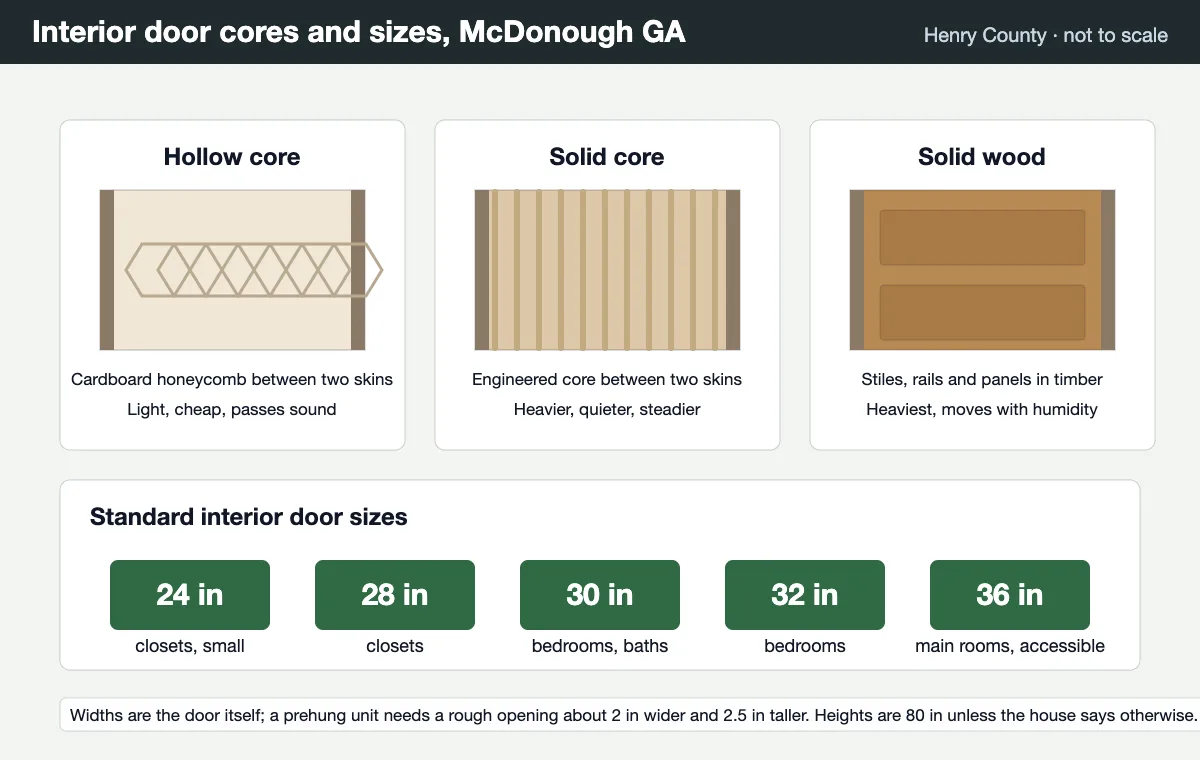
The core is what you are actually buying. Hollow core doors are light enough to hang on their own hinges with no trouble and cheap enough to do a whole house at once, and they pass sound like a sheet of card, because that is largely what is inside them. Solid core doors feel like a door, close with a thud and keep noise where it belongs, which is why they land on bedrooms, bathrooms and home offices first.
| Opening | Common choice | Why |
|---|---|---|
| Closets and pantries | Hollow core | Nothing to hear, nothing to carry |
| Bedrooms | Solid core where budget allows | Sound between rooms is the whole point |
| Bathrooms | Solid core | Same reason, plus the door feels substantial |
| Home office | Solid core | Calls and meetings through a hollow door carry |
| Laundry rooms | Solid core | Machines are the loudest thing in most houses |
| Older houses with original trim | Solid wood slab | Matches what is already there |
Swipe the table sideways to see every column →
General practice rather than a code requirement. Weight matters: a solid core door on tired hinges will need the hinges upgraded too.
Prehung or slab in an older house
This is the decision that separates a good interior door job from a frustrating one. A slab reuses the jamb you already have, which keeps the casing and the paint lines intact. It only works if that jamb is square, the hinge mortises line up with the new door and the strike is where the latch expects it.
- Check the jamb for square with a level on both sides and across the head.
- Measure the door, not the opening, if you are buying a slab.
- Count hinges and measure their size and the mortise depth, because a slab has to be mortised to match.
- Look at the latch height and the strike position before ordering a pre-bored slab.
- Expect a prehung unit's rough opening to run roughly two inches wider and a couple of inches taller than the door itself.
- Budget for casing on at least one side with any prehung unit.
Hardware, swing and the small decisions
Bore and backset
Pre-bored doors come with a 2 1/8 inch hole for the knob and a backset, the distance from the edge to the center of that hole, that is usually 2 3/8 or 2 3/4 inches. Buying hardware that matches saves a trip. The door hardware page covers the rest.
Which way it swings
Handing is set by which side the hinges are on and which way the door opens, and a prehung unit is built one way or the other. Stand in the opening facing the direction the door swings away from you and note which side the hinges fall. Get it wrong and the unit goes back.
Doors that are not doors
Bifolds, pocket doors and barn-style sliders all solve the swing-space problem differently. Pocket doors mean opening the wall, which is a bigger job than it looks and worth pricing separately before committing.