Deadbolt and door hardware in McDonough, GA: the strike plate is the weak point
Most people shop for the lock. The part that decides whether a door holds is the strike plate and the screws behind it. A door jamb is usually three quarters of an inch of trim nailed to the framing, with a gap behind it. Screws that stop inside that trim hold nothing in a real impact.
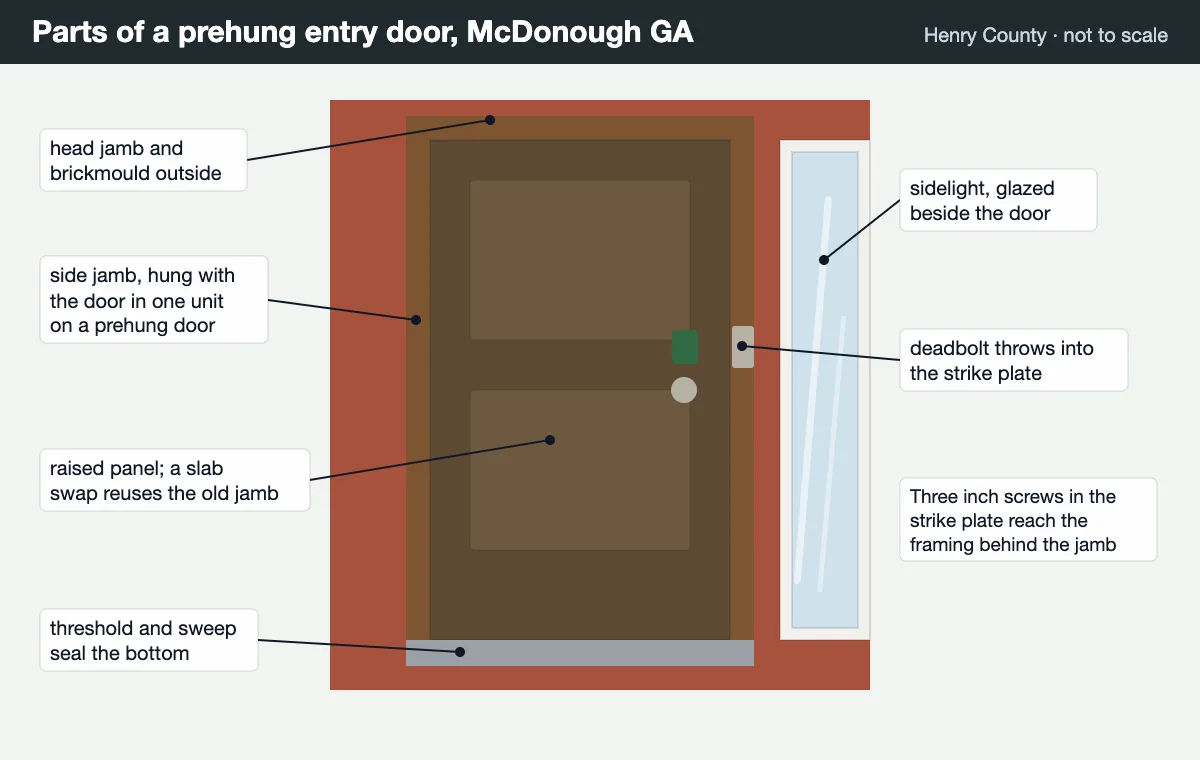
- Swap the short screws in the strike plate for three inch screws that reach the framing.
- Do the same on the top hinge, which carries most of the door's weight.
- Use a box strike or a reinforced strike plate if the jamb is already split.
- Check the bolt throws fully without being lifted. A partly thrown bolt is barely a bolt.
- On a door with glass beside it, use a thumbturn you cannot reach through a broken sidelight, or a double cylinder with the keys kept somewhere sensible.
Picking the hardware itself
| Term | What it means | What to do with it |
|---|---|---|
| Grade 1, 2 or 3 | ANSI and BHMA strength and cycle ratings, Grade 1 highest | Grade 2 or better on an entry deadbolt |
| Backset | Edge of door to center of the bore, usually 2 3/8 or 2 3/4 in | Measure before buying, most locks adjust between the two |
| Single or double cylinder | Thumbturn inside, or a key on both sides | Double cylinder near glass, with the key accessible to people inside |
| Handleset | Exterior handle and deadbolt as one matched unit | The usual look on a front door |
| Keyed alike | All locks on one key from the factory | Easiest when every lock is the same brand |
| Smart lock | Keypad, app or both, over a standard deadbolt | Convenience; the strike screws still do the hard work |
Swipe the table sideways to see every column →
Grades are published by ANSI and BHMA, and the grade is normally printed on the retail packaging. Everything else here is standard hardware terminology.
When hardware is not the problem
The door has dropped
If you have to lift or push the door to get the bolt home, the alignment has moved. Tighten the hinge screws first, replace the top hinge screws with long ones second, and only then look at the strike. Filing the strike opening bigger hides the problem and makes the bolt engage less.
The jamb has gone soft
Rot at the bottom of the strike jamb is common on porches with short overhangs, and no screw length fixes wet wood. That is carpentry, and it usually comes up as part of a front door replacement.
It is a patio door
Sliding doors latch with a hook rather than a bolt, so the upgrades are different: a secondary foot bolt, a bar in the track, or an anti-lift measure. The patio door page covers those.