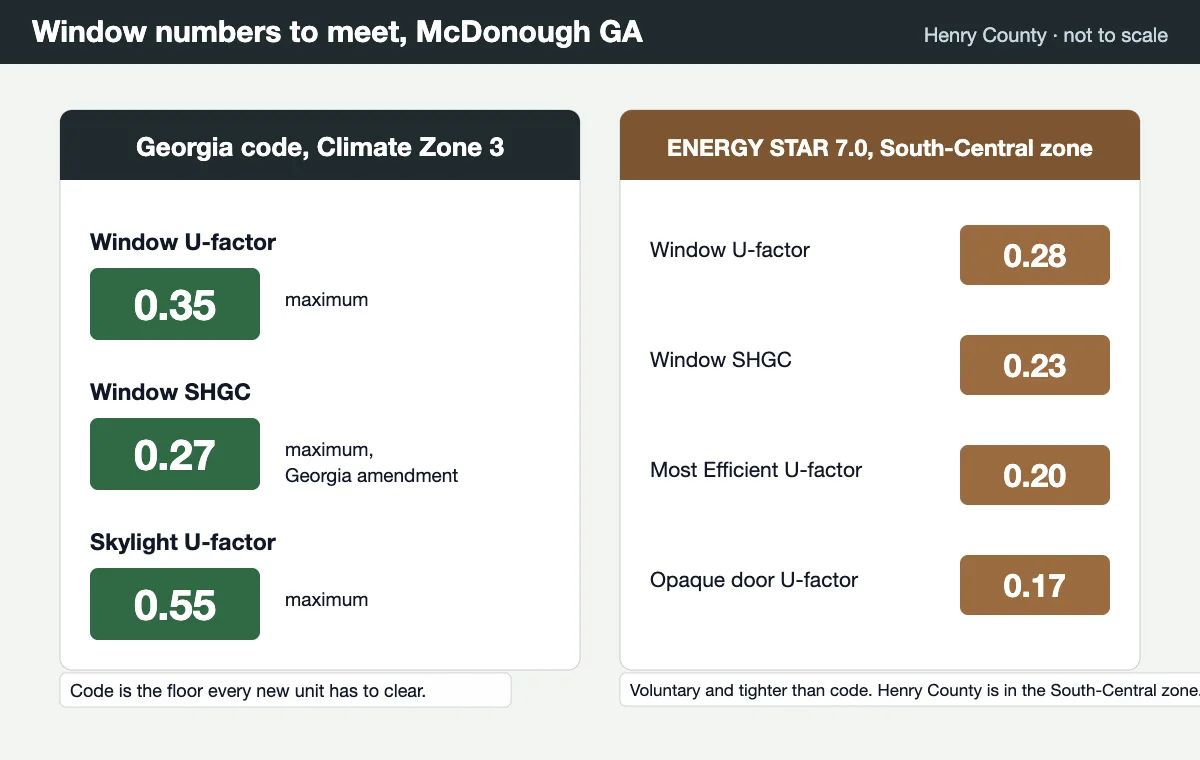
The two numbers Georgia sets for a new window
A replacement window in Henry County has to come in at 0.35 or lower on U-factor and 0.27 or lower on SHGC. Henry County confirms Climate Zone 3 on its own residential energy code compliance affidavit, and those are the figures the Georgia-amended energy code sets for that zone, with skylights allowed up to 0.55.
| Figure | Georgia code, Zone 3 | ENERGY STAR, South-Central | What it measures |
|---|---|---|---|
| Window U-factor | 0.35 maximum | 0.28 maximum | Heat moving through the whole unit, frame included. Lower is better. |
| Window SHGC | 0.27 maximum | 0.23 maximum | Share of the sun's heat let through, 0 to 1. Lower is better here. |
| Skylight U-factor | 0.55 maximum | Set separately by product type | Same as U-factor, measured on a sloped unit. |
| Air leakage | Not set in this table | 0.3 cfm per sq ft or lower | Air passing through the assembly under test pressure. |
| Opaque door U-factor | Not set in this table | 0.17 or lower | Heat through a solid entry door. |
Swipe the table sideways to see every column →
Code figures: Georgia amendments to the International Energy Conservation Code, Table R402.1.2, Climate Zone 3. ENERGY STAR figures: version 7.0, effective October 23, 2023, for the South-Central climate zone, which is the zone ENERGY STAR's own finder returns for Henry County, Georgia.
Three tiers, one address
Everything above collapses into three lines. The first is a legal requirement, the second and third are voluntary labels a manufacturer earns. ENERGY STAR's own climate zone finder places Henry County in its South-Central zone, which is what sets the second row.
| Standard | U-factor | SHGC | Status |
|---|---|---|---|
| Georgia code, Climate Zone 3 | 0.35 or lower | 0.27 or lower | Required |
| ENERGY STAR, South-Central zone | 0.28 or lower | 0.23 or lower | Voluntary label |
| ENERGY STAR Most Efficient | 0.20 or lower | 0.23 or lower | Voluntary, top tier |
Swipe the table sideways to see every column →
Code figures from the Georgia amendments to the energy code for Climate Zone 3, with the 0.27 SHGC being Georgia's own amendment. ENERGY STAR figures from its version 7.0 criteria for the South-Central zone, which is the zone its climate zone finder returns for Henry County, Georgia. Read October 2026.
The practical reading: a window that merely clears code can be a third less efficient on U-factor than one carrying an ENERGY STAR label for this zone, and more than half as efficient as a Most Efficient unit. None of that makes a code-compliant window a bad window. It does mean the words energy efficient on a quote are worth nothing without the two numbers beside them.
Why SHGC does more work than U-factor here
U-factor is about keeping heat in on a cold night. SHGC is about keeping the sun's heat out on a hot afternoon, and Georgia has far more of the second problem. NOAA's state climate summary describes long, hot and humid summers, with the Atlanta area averaging seven days a year above 95 degrees and summers that have warmed since 1900. The Department of Energy's own guidance is one sentence long: the lower the SHGC, the less solar heat the window lets in.
A useful way to see the difference: ENERGY STAR's southern criteria cap SHGC at 0.23, while its northern criteria set a minimum rather than a cap, because up there the winter sun through the glass is free heat. A window specified for Ohio is the wrong window for Henry County, and it will still carry an ENERGY STAR logo.
What the glass package actually contains
Behind those two numbers sit a handful of choices your quote should name:
- Low-E coating: a microscopically thin metal layer on the glass. The tuning decides how much solar heat gets through, which is where your SHGC number comes from.
- Gas fill: argon between the panes slows heat transfer and lowers U-factor.
- Spacer: what holds the panes apart at the edge. A warm-edge spacer cuts the cold line around the glass, and the spacer seal is the part that fails on a fogged unit.
- Pane count: two is standard in Georgia, three buys U-factor you mostly do not need here.
- Frame material: vinyl, fiberglass, aluminum and wood all conduct heat differently, which is why U-factor is measured on the whole unit, not the glass.
Low-E does something else worth knowing about in a bright climate. The Department of Energy says low-E coatings can protect household furnishings from UV-induced fading by as much as 75 percent. If a south-facing room has bleached a rug or a hardwood floor, that is the number to bring up.
Installation decides whether the numbers survive
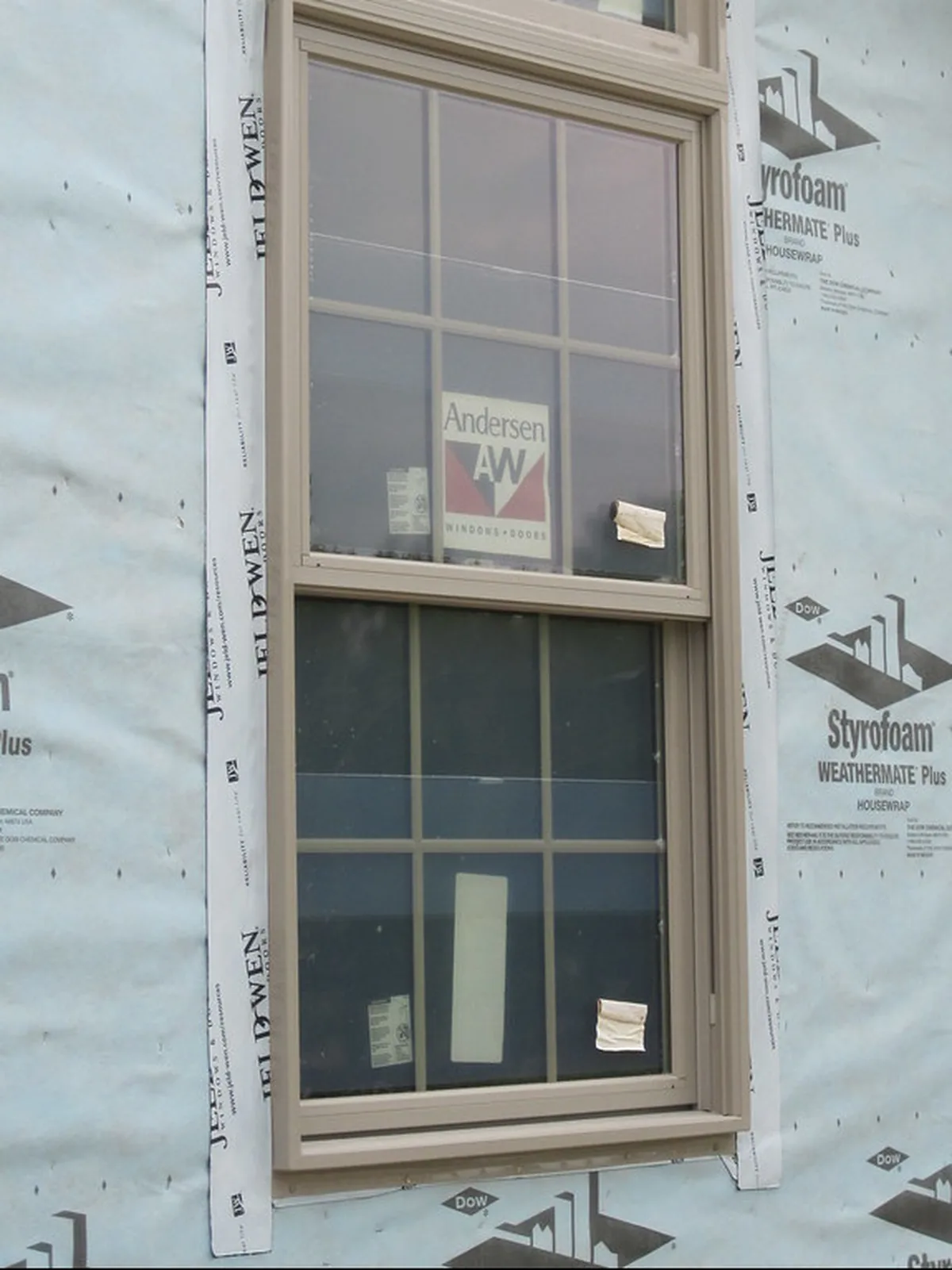
Georgia's own code amendments make the point in their commentary: air infiltration accounts for substantial heat loss, heat gain and moisture migration in a building, and proper sealing around all doors, windows and other envelope penetrations is as important to code compliance as insulation R-values and component U-factors. The Department of Energy says the same thing from the other direction: even the most energy-efficient windows can result in a drafty house and moisture condensation if they are not properly installed.
Which is to say a 0.27 SHGC unit fitted badly performs worse than a plainer unit fitted well. Window installation covers what belongs in the gap between the frame and the framing.
What efficiency is worth at resale
The Department of Energy's window guide puts the resale recovery on a window project at about 78 percent of the cost. That is a national figure rather than a Henry County one, and it is a useful counterweight to both the sales pitch that windows pay for themselves and the assumption that they are money thrown at the wall. For what the job itself costs here, see the McDonough window replacement cost guide.